Schacht Henriette
Stolberg
Operating Point from Diepenlinchen until 1885
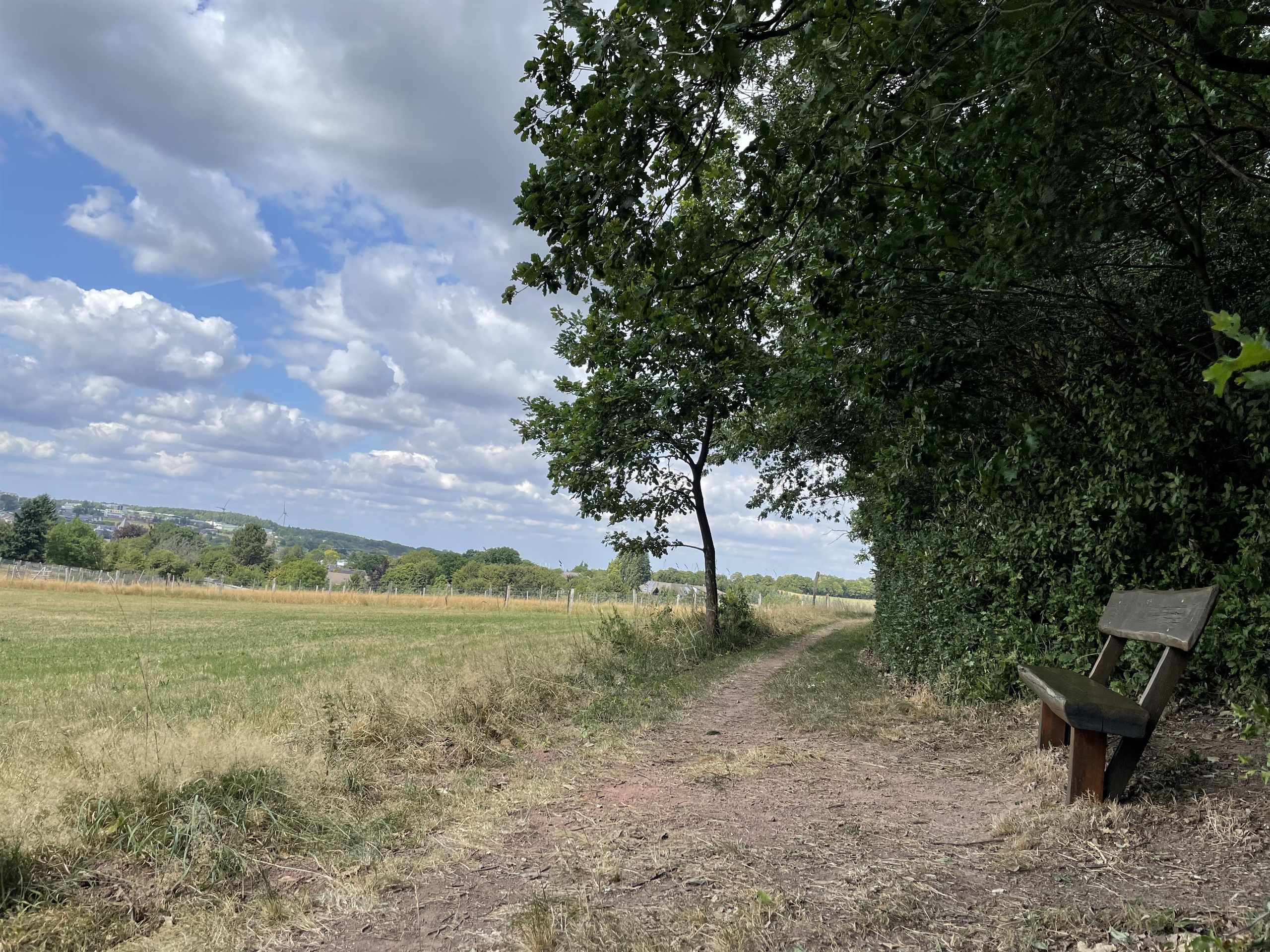
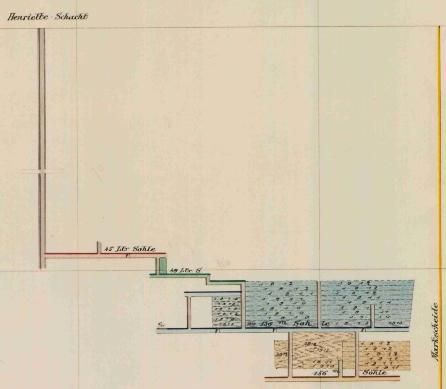
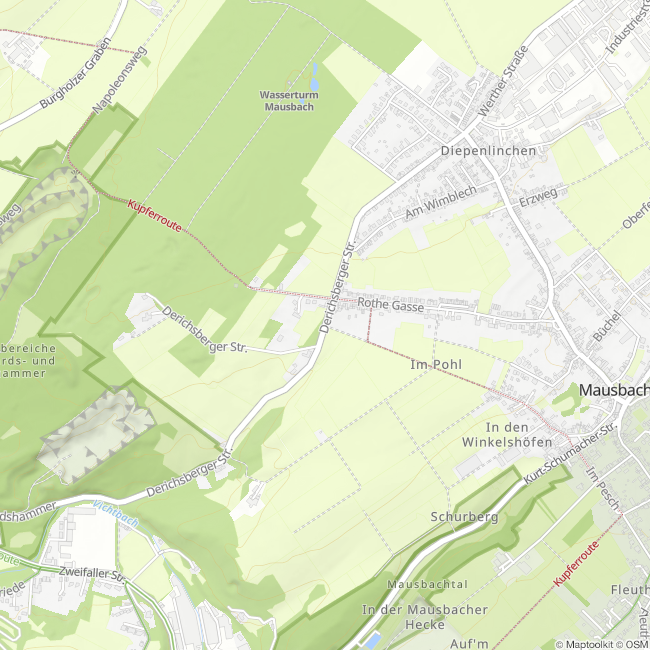
Not far from this sign (400 m), at the junction of Derichsberger Straße, lies Shaft Henriette. The complex consists of three shafts for water management and extraction, both reaching a depth of 84 m, the "Old Shaft" with a depth of 35 m, seven buildings, sheds, and an ore washing facility, making it one of several operating points of the Großerzgrube Diepenlinchen.
The ore washing facility was presumably supplied with water from the water management shaft, and the wastewater flowed first south into four settling basins and then west (on the other side of Derichsberger Straße) into the now dry valley floor, and from there between "Untere Derichsmühle" and "Bernardshammer" into the Vichtbach. Above ground, the settling basins, remnants of waste heaps with galmei flora, and the filled shaft craters are still visible.
Like at other operating points, e.g., Ravelsberg, Mausbacher Heck, a small ore nest that was not connected to the water management of the main mine complex was extracted at the Henriette operating point. The nest was located at an average depth of about 75 m with an approximate size of 33 m x 20 m. Two veins with a small thickness (20 cm to 130 cm) and a length of about 60-100 m (Vein 1) and 100 m (Vein 2) were driven and extracted adjacent to it.
As is common in the Stolberg ore district, such ore veins and nests were found in natural fractures of the limestone as well as at the transitions between limestone and slate of the Werther Mulde. The depth of all three shafts indicates a near-surface occurrence, which was thus accessed quite early in the history of the mine and was exhausted by 1885. Also typical is the found position of the ores. Near the groundwater level, white lead ore (PbCO3) and galmei (particularly ZnCO3) were extracted, both weathering ores of the originally formed sulfidic ores galena (PbS), sphalerite (ZnS), and pyrite (FeS2), which were found at greater depths. The extracted nests and veins should not be imagined as massive ore deposits, but rather as accumulations around the shattered limestone body in the fracture zones.
At the Henriette operating point, geodes with a calcite core and shell-shaped deposits of galena, sphalerite, and pyrite in alternating layers were frequently found, or the ore formed a filler material between the broken dolomite or calcite fragments. The so-called nests are nothing more than fracture zones larger than the veins.
On the site of the operating point are the blasted remnants of two bunkers 155 and 157 (both standard construction 10, group shelter) of the West Wall, which were built in 1938/39 and were taken over by US troops without a fight and blown up on September 16, 1944.
Impressions

Contact
Panoramarundweg Mausbach
52224 Stolberg