Erste Schule Mausbach
Stolberg
In the early 19th century, the parish’s founder, Arnold Salmagne, entrusted the tailor and sexton Laurenz Schmitz with teaching the youth; classes were held only in the winter.
In the summer, the children were on vacation because of farm work.
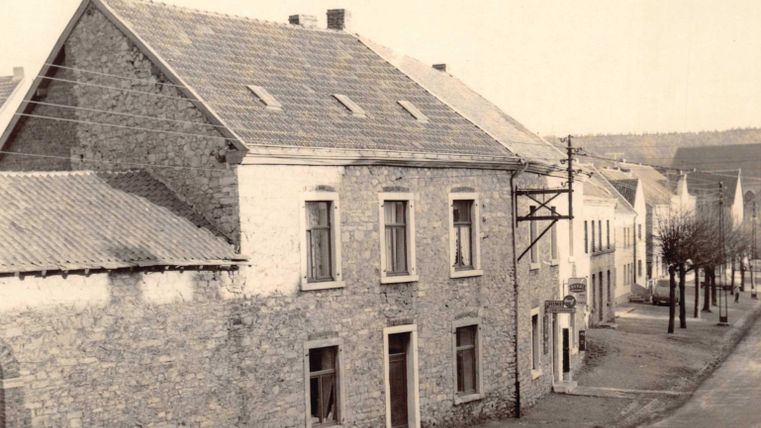
Sexton’s House “Am Pütz” – Essiger Straße 54
At the beginning of the 19th century, the parish founder Arnold Salmagne commissioned the tailor and sexton Laurenz Schmitz to take over teaching the village youth during the winter. During the summer months, however, school was completely suspended, as the children were needed for farm work. After Schmitz’s death, Salmagne appointed the weaver Kaspar Winter as the new sexton and schoolteacher. Classes were held in the sexton’s living room at Am Pütz.
The learning conditions were simple: the older students sat at the table, the middle-aged students on benches along the walls, and the youngest children on the floor. Slate slates were often obtained from the church roof, as it was the only one covered with slate tiles, while all the other houses had thatched roofs. After every storm, people would therefore search the area around the church to find usable slates. Students who were already writing with pen and ink received goose quills carefully trimmed by their teacher.
The schoolmaster received his wages mainly in the form of goods in kind, such as bread, butter, grain, bacon, firewood, and seasonal fruits. In winter, each child also brought a log every day to heat the stove in the classroom. In addition, many teachers were entitled to what was known as the “wandertisch”—a daily meal provided by a different student’s family each day. Schoolmaster Winter resigned from his post in 1836, after which the town’s first certified teacher, Anton Breuer, succeeded him.
On January 21, 1858, a fateful incident occurred: Breuer punished 11½-year-old Jakob Salmagne because he had turned in an inadequate essay and removed pages from his notebook. According to Peter Anton Breuer, the punishment consisted of several slaps with the flat of the hand. The next day, the teacher received word that Jakob had been unable to walk since the punishment. A court case followed, in which Breuer was sentenced on October 13, 1858, to one year in prison, ordered to pay all costs, and barred from practicing his profession for two years.
Breuer later claimed that Pastor Matthias Grein, as well as the village mayor and blacksmith Bernard Flamm, had influenced the harsh sentence through intrigue. With a new attorney, he filed an appeal. The Court of Appeals ultimately reduced the sentence to three months in prison, coupled with the obligation to bear all costs. A petition for clemency to Wilhelm of Prussia on May 21, 1859, was unsuccessful.
Breuer was consequently required to begin serving his sentence in Aachen the following Monday. From May 23 to August 21, 1859, he served his sentence there and was assigned to the administrative office. Upon his release, 40 to 50 of his students greeted him at the train station in Stolberg. Nevertheless, he had to continue on to Eschweiler, as he was to receive instructions there from School Inspector Deckers. On August 22, 1859, Breuer finally returned to his post in Mausbach and taught there until 1876.
Girls’ School
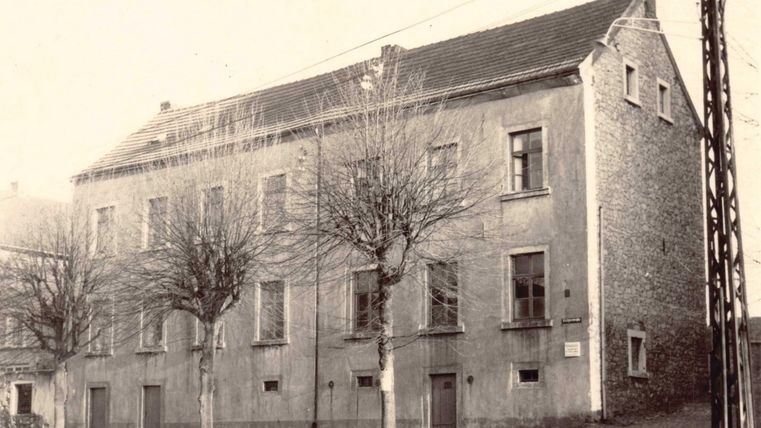
On the former Essiger Straße
As early as 1815, shortly after the Rhineland became part of Prussia, the government recommended that the municipality build its own schoolhouse. However, the Gressenich municipal council refused to provide the necessary lumber, so the project was postponed for more than two decades. It was not until a few years later, when compulsory education was introduced and the number of children rose from 40 to 105, that the pressure increased—at times, classes even had to be held in shifts.
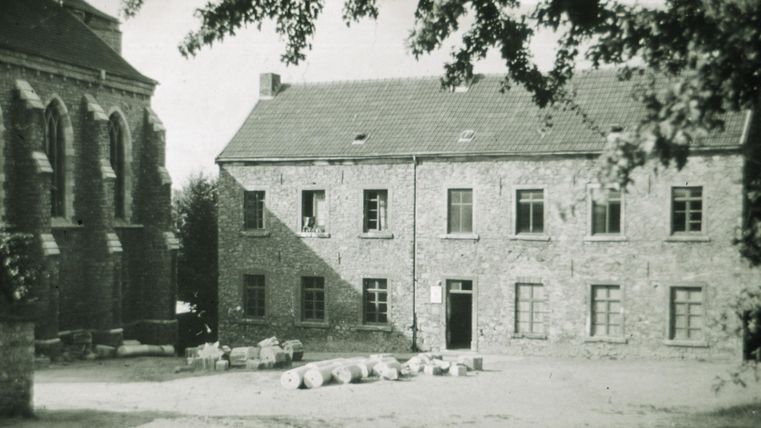
According to the municipal chronicle, the new school building was finally completed in 1837, with a teacher’s apartment on the upper floor. A year later, in 1838, Pastor Rübsteck solemnly blessed the building, and classes could begin. At that time, the boys attended school at the market square, while the girls were taught in the building on Essiger Street.
Due to strong population growth, the school building was expanded several times: an additional classroom was added in 1850, and a third classroom in 1865. The building served as an elementary school until 1940, after which it was converted into a district agricultural vocational school.
After World War II, the municipality used the building as a youth center, a public library, and a venue for municipal committee meetings. Historical photos still show fragments of the St. Markus parish church—which was destroyed during the war—in the vicinity of the building. These column remnants, which were no longer needed during the church’s reconstruction, were later moved to the Diepenlinchen industrial park, where they were used as building material. Plans to convert the school building into a post office were ultimately abandoned.
The building was demolished in 1964–65.
Impressions
Contact
Dorfhistorischer Rundweg
52224 Stolberg-Mausbach